Patios · Walkways · Driveways
Interlock in Ottawa, built from the base up.
Paver patios, walkways and driveways that stay flat through decades of freeze and thaw. The difference between interlock that lasts and interlock that heaves is almost entirely underneath, in the part of the job you never see.
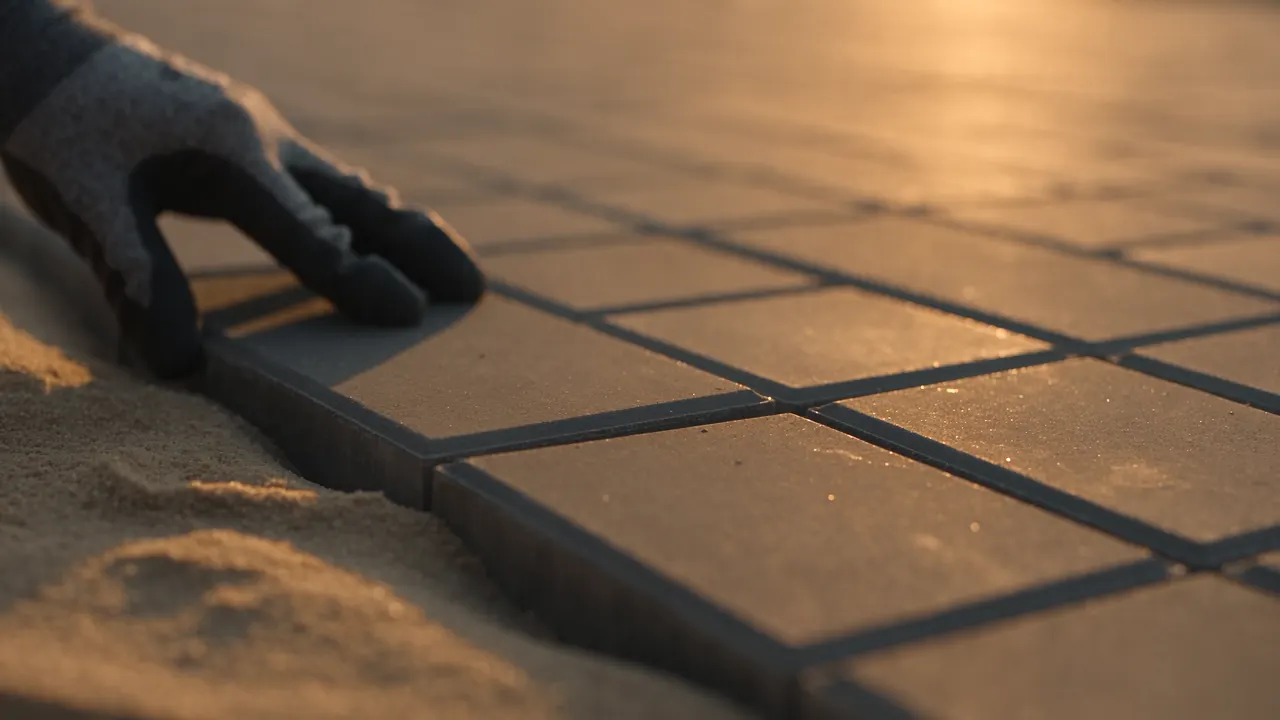 Herringbone, set by hand
- Typical projects
- Back patios, front walkways, steps landings, driveways and pool surrounds
- The part that matters
- Excavation depth and a compacted granular base
- Rules to know
- City hardscaping licence, Access By-law for driveways, utility locates
- Best season
- Late spring to fall, once the ground can be compacted
Why interlock works in Ottawa
Concrete pavers are one of the few hard surfaces that cope gracefully with a climate like ours.
Flexible by design
An interlocking pavement is made of hundreds of separate units, locked together by sand in the joints and held at the edges by a restraint. When the ground underneath moves a little, as it does every winter in Ottawa, the pavement flexes with it instead of cracking the way a poured slab does. And if something does go wrong, a section can be lifted, the base repaired and the same pavers put back.
Pavers made in Canada are produced to the CSA A231.2 standard for precast concrete pavers, which sets a high minimum strength and a freeze-thaw test in salt water. That is why good-quality pavers shrug off road salt and plows that would scale a cheaper surface.
But only as good as the base
Pavers do not hold anything up. The base does. Industry guidance from the Interlocking Concrete Pavement Institute sets minimum compacted aggregate base thicknesses of about 100 mm (4 inches) for walkways and patios and 150 mm (6 inches) for residential driveways, compacted to a high density, with more where soils are weak, wet or subject to freezing. Much of Ottawa is all three: marine clay that holds water, and frost that National Research Council work here measured going more than a metre deep.
In practice that means digging out the soft topsoil and organic material, building the base up in compacted layers, setting the grade so water runs off the surface and away from the house, and only then screeding a thin, even layer of bedding sand for the pavers. A quote that is noticeably cheaper than the others very often has less base in it.
How an interlock project is built
The same sequence for a small walkway or a full driveway; only the depths and equipment change.
Layout and locates
The shape is marked on the ground from the plan, grades are set with string lines, and utility locates are requested through Ontario One Call at least five business days before digging.
Excavation
Soil is dug out to the depth the base and soil conditions need, and removed from site. Soft spots are dug deeper; a geotextile fabric is often laid on clay to keep the base from mixing into it.
Granular base
Crushed aggregate is placed and compacted in lifts with a plate compactor, each layer checked for grade, until the base sits at the right height with a slope for drainage.
Edge restraint
A restraint is fixed along the edges so the field of pavers cannot creep outward over time. Without one, joints open and the pattern drifts.
Bedding sand and pavers
A thin, uniform layer of bedding sand is screeded flat, the pavers are laid in pattern, and edges are cut to fit.
Compaction and joints
The surface is compacted to seat the pavers, then joint sand is swept in and compacted again so every unit is locked to its neighbours. Polymeric joint sand, which hardens when wetted, helps resist weeds and washout.
Patterns, and why they matter
The laying pattern is not only about looks. In a driveway, a herringbone pattern spreads the turning and braking forces of tires across many joints and resists creeping far better than a running bond, which is why the industry recommends it for anything that carries cars. For patios and walkways, the choice is more open: running bond feels calm and linear, basketweave reads traditional, large-format slabs look modern and need the most precise base work, because a big slab shows every bump.
Border courses, often a row of pavers set end to end in a contrasting colour, frame the field, hide the cut edges and make a patio look finished. Curves and angles add cutting time and waste, which is worth knowing when you compare a curved design with a square one.
What we build in interlock
Every one of these can be combined with steps, seat walls and lighting from the same plan.
Driveways and City rules
Driveways are the interlock project most affected by City rules. The part of a driveway on your property is governed by the Zoning By-law, which limits how much of the front yard can be paved. The part that crosses the City right of way to the street is covered by the Access By-law, which came into force on April 8, 2026 and replaced the old Private Approach By-law.
Under the Access By-law, building, widening or closing a driveway access needs a permit, though some modest driveway extensions and walkways can now be built without one if they meet the rules, and resurfacing an existing access does not need a permit. Driveways are limited to no more than half of the lot's frontage, which keeps room along the street for winter storage of plowed snow and for trees. Permeable surfaces are allowed.
Since 2026, businesses that build or change driveways, walkways and patios in Ottawa also need a City hardscaping business licence. The City recommends asking for a copy of the licence and a written contract before work starts.
Choosing the pavers
Pavers differ in more than colour. These are the choices that matter most, and what each one changes.
How to compare interlock quotes
Quotes for the same patio can differ a lot. Usually the difference is in what you cannot see.
Ask what is underneath
Every quote should say how deep the excavation goes, what base material is used, how thick it will be once compacted and how it is compacted. If two quotes differ by a large amount, the base is the first place to look. A quote that does not mention the base at all is a warning sign.
Ask about the edges and the joints
An edge restraint is not optional; without it a paver field spreads over time. Ask what restraint is used and how it is fixed, and whether the joint sand is regular or polymeric.
Ask about the paperwork
In Ottawa, a hardscaping business needs a City business licence, should give you a written contract, and should request utility locates before digging. If the work touches the City right of way, ask who is getting the access permit. These are quick questions, and the answers tell you a lot about how the rest of the job will be run.
When interlock needs repair
One of the great advantages of interlock is that it can be fixed without replacing it. A sunken section by the garage, a heaved strip where a downspout empties, or a patch disturbed for a utility repair can be lifted, the base rebuilt and compacted, and the same pavers relaid, so the repair matches the rest of the surface.
Before repairing, the cause has to be found. Settling usually means a soft spot or too little base; heaving usually means water getting underneath and freezing. Redirecting a downspout, adding a drain or regrading beside the paving often matters as much as the repair itself. Old interlock that has heaved everywhere, with joints washed out and a base that has failed across the whole area, is usually better rebuilt from the base up.
Material calculator
Rough quantities for a patio, walkway, driveway, new lawn or planting bed, so you can sanity-check a quote. Base depths shown are the industry minimums; Ottawa clay and frost often call for more, and your installer sets the final depth after seeing the soil.
Living with interlock
Pavers need very little, but a few habits keep them looking new for decades.
Winter
Shovel and plow normally; good pavers handle it. Go easy on salt, especially in the first winter, and follow the paver maker's guidance on de-icers. Sand or a calcium-based product gives traction with less risk to the surface and to the plants and lawn beside it.
Joints and weeds
Joint sand settles over the first year and can be topped up. Polymeric sand resists weeds and ants, but no joint is weed-proof: seeds blow in and germinate in the dust on top. A stiff broom and an occasional top-up of joint sand do most of the work.
Stains and sealing
Oil, rust and leaf tannin stains can usually be lifted with products made for concrete pavers. Sealing is optional; it can deepen colour and make cleaning easier but needs renewing every few years. If a single paver is badly stained or cracked, it can be lifted out and replaced.
Questions people ask.
How deep should an interlock base be in Ottawa?
Industry minimums are about 4 inches (100 mm) of compacted aggregate for patios and walkways and 6 inches (150 mm) for residential driveways, but those are minimums for good soil. Ottawa's clay and frost usually call for more. The right depth is set after looking at the soil on site.
Is interlock better than poured concrete or asphalt?
Each has a place. Interlock flexes with frost instead of cracking, can be repaired by lifting and resetting pavers, and offers far more design choice. It usually costs more to install than asphalt. A well-built concrete slab can last a long time but is hard to repair invisibly.
Why is my interlock sinking or heaving?
Usually a base problem: too little granular base, poor compaction, a soft or wet spot underneath, or water running under the edge. Downspouts emptying onto pavers are a common culprit. Most cases can be fixed by lifting the area, rebuilding the base and relaying the same pavers.
What is polymeric sand, and do I need it?
It is joint sand mixed with a binder that hardens when wetted, helping the joints resist weeds, ants and washout. It is popular on patios and walkways. It has to be installed carefully, on a dry surface, to avoid a haze on the pavers.
Do I need a permit for an interlock driveway in Ottawa?
If the work builds, widens or closes the access where the driveway crosses the City right of way, an access permit is usually required under the Access By-law. Resurfacing an existing access does not need one, and some modest extensions can be done without one if they meet the rules. Driveways are limited to half of the lot frontage.
How long does an interlock patio take to build?
Most residential patios and walkways take a few days of work once started, depending on size, access, how much soil comes out and the weather. Driveways and projects with walls or steps take longer.
More from Ottawa Landscaping Pros
See the whole process, from grading to lighting, on the main page for landscaping in Ottawa, where a backyard builds itself as you scroll. Or go straight to a service or an area.
Start with a conversation
Tell us about your yard
613-851-7831Call for the quickest answer, or send the form and you will get a call back to talk through the yard, the timing and what a site visit involves.